Log Cabin Acorn
I picked this up recently:
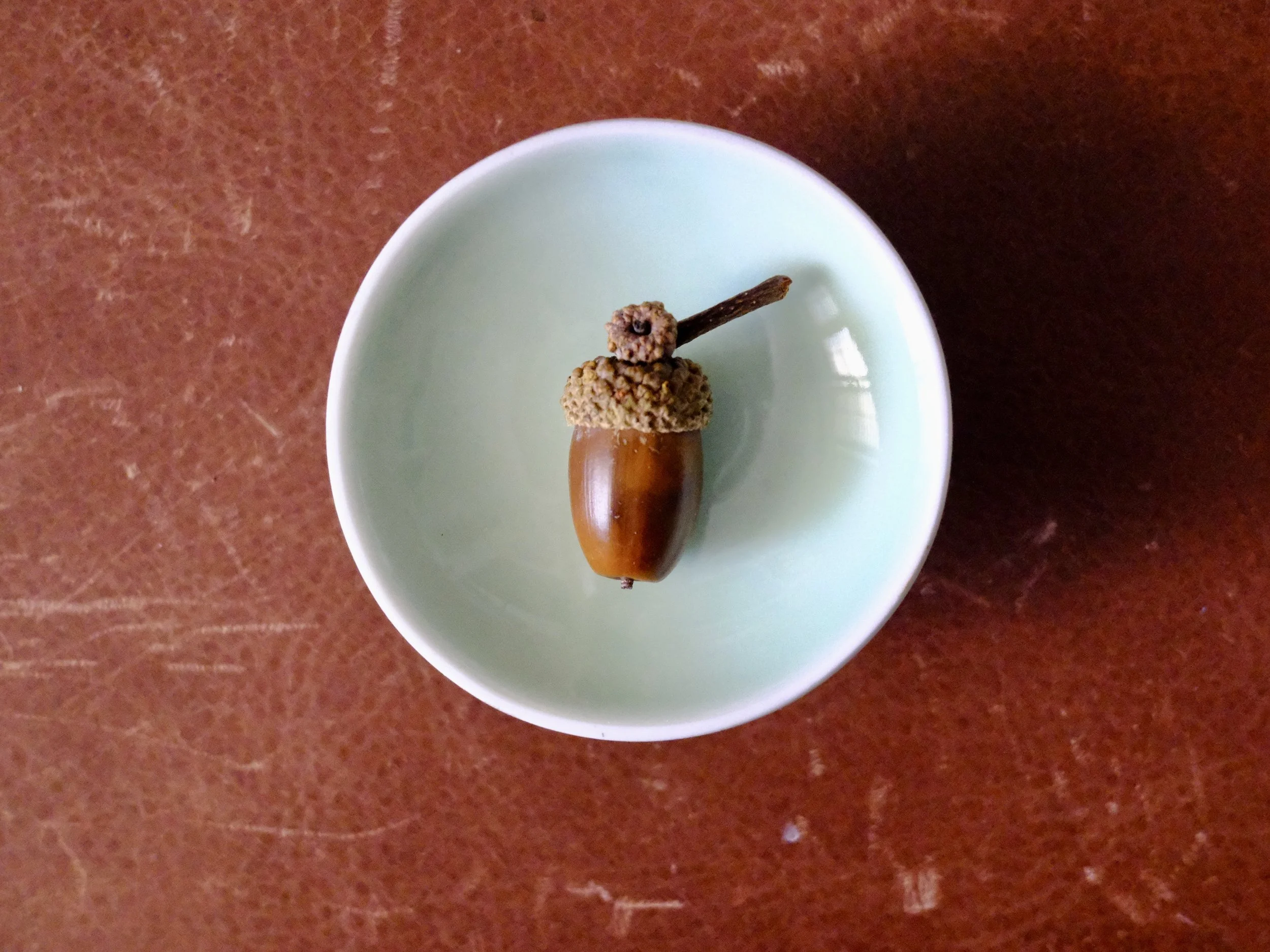
It’s an acorn.
Acorns are the hard-shelled fruit of oak trees and a single giant oak can drop as many as 10,000 acorns in a single year, though (for reasons as yet unknown) oaks—like many other trees—experience cycles of higher or lower seed production. [1]
The word acorn is closely related to the word akran, from the extinct language of the Goths meaning, “fruit of the unenclosed land.” [2]
I’ve always loved acorns. The shiny brown shell. The smooth clatter when you rattle them either individually or many together. They feel like some perfect sort of currency, the seeds of a giant tree each one capable of making more giant trees with only soil and water and sunlight.
Acorns are too heavy to be dispersed by wind and so oaks rely on wildlife to spread them. A bird or a squirrel will pick it up, drop it somewhere else, far away. And I suppose that’s what I’ve done as well.
I picked up this acorn a few weeks ago, while I was in Swannanoa, North Carolina. I was walking with my mamma on the land that has fed and sheltered my family for several generations.
My parents and I moved into an old cabin on this land when I was itty-bitty, so small that many of my very first memories were formed there: playing in snow, picking morning glories, learning hard lessons about unfixable slinky kinks.
I picked up acorns then, from this same tree, showed them to ma mamma. Listened to her about fairies wearing the acorn caps as hats, went searching.
Now, I am back in California and my mamma says, “They might have to cut down that old oak by the cabin.”
“Why?” I ask.
“It’s been eaten up by wasps.”
“Oh.”
She tells me, “It’s an old tree. It was planted in the 1930s, I think. It’s had a good life. It’s fed a lot of turkeys and bears.”
“I got an acorn while I was there,” I tell her. “I brought it back with me.”
And I pick up the acorn again, study its shiny armor, listen to the seeds rattle within. Waiting, ready.
Fruit of the unenclosed land.