Hardy Poison Eater
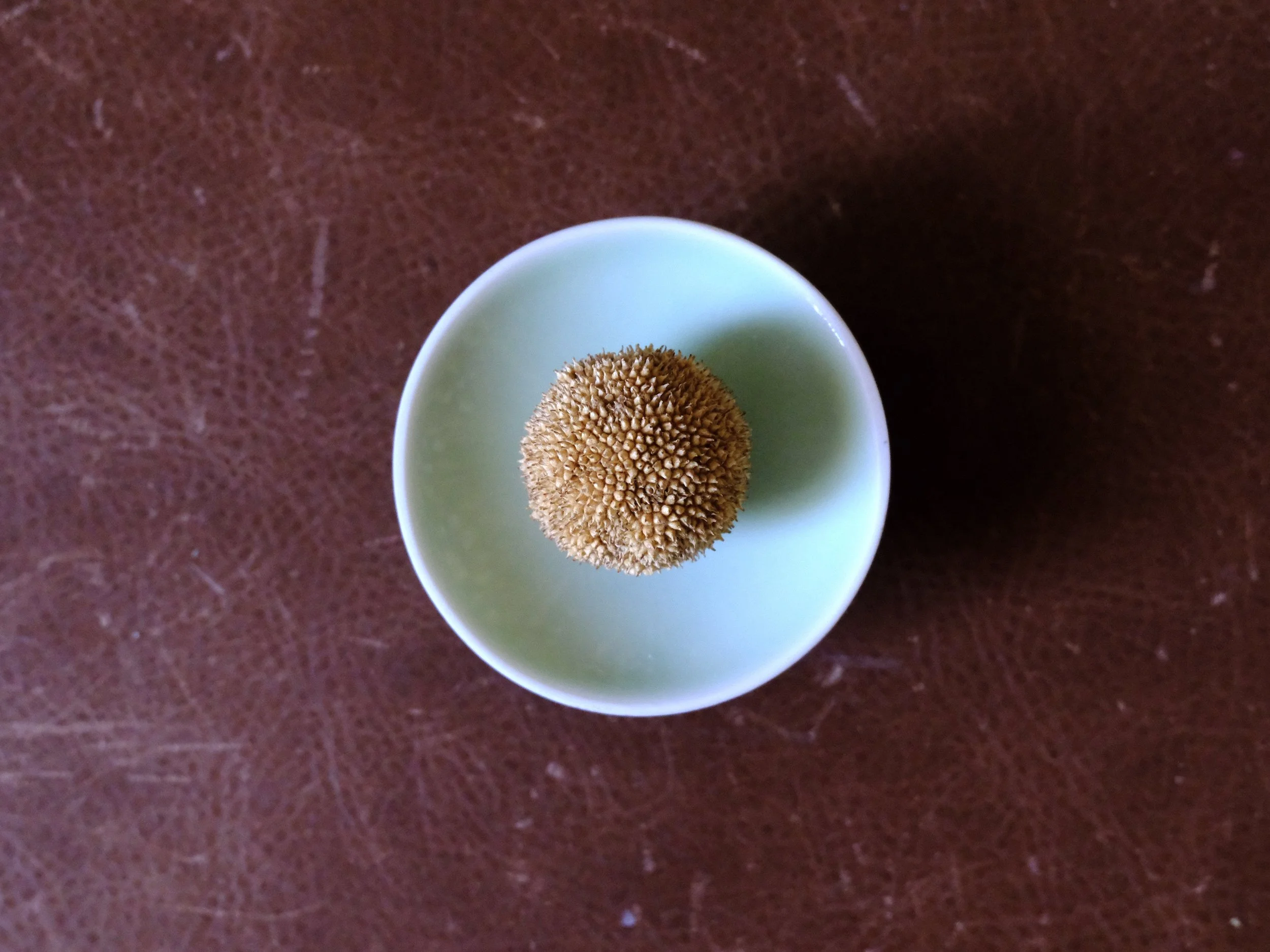
The seed ball of a London Plane Tree
No one really knows how London Plane Trees happened. Likely an unintentional hybrid of an Oriental Plane and an American Sycamore,[1] the trees probably emerged in Spain or France sometime in the 1700s but became famous as the only trees that could survive the toxic atmosphere of Victorian London. And the air was indeed very toxic:
“Smoke lowering down from chimney-pots, making a soft black drizzle, with flakes of soot in it as big as full-grown snowflakes—gone into mourning, one might imagine, for the death of the sun.” -Bleak House, Charles Dickens 1853
The London Plane is a master of carbon storage and the young leaves are covered in tiny hairs which protect them from the sun and trap airborne pollutants.[2] Toxins are also absorbed into the bark, which drops off in powdery sheets at the end of each year. The tree is extremely drought and wind resistant and the mature leaves, with their broad, maple-like shape provide ample shade.
Naturally, then, this is the perfect tree for the urban environment. Indeed, they have been planted in in cities around the world from Adelaide to New York to Zurich.[4]
They’re certainly ubiquitous where I live, a community near Los Angeles that was planned (and planted) in the 1970s, when leaded gasoline was the norm and L.A. was at it’s smoggiest and most piss-colored.

Of course, everything has a downside. Even as London Planes clean the air, they shed problems for allergy sufferers and asthmatics (I’m in both of these categories) as they drop bucket loads of pollen and the leaves release their lung-irritating hairs into the air.
Equipped with this new knowledge, awareness, and ever-present inhaler, I confess I feel a little ambivalent. After all, these trees (shedding their hair and their pollen) are everywhere here. Every street, every parking lot, shading every sidewalk around every park.
But maybe my perspective is just too anthropocentric. The trees capture, store, and clean human pollution. They release irritants to human airways.
The house finch, meanwhile, isn’t bothered by the London Planes. This little bird nests in their branches and flutters among their leaves and makes hearty meals of their seeds.
So, on these walks around my neighborhood, my lungs might burn and my eyes might sting but my ears also fill with the house finch’s song (which is especially sweet) and I decide that the irritation to my sinuses and lungs is a small price to pay.
I take another puff of my inhaler and enjoy the sound.